
Website : https://www.igbmc.fr/plateformes-technologiques/biophysique-moleculaire
BIO-LAYER INTERFEROMETRY (BLI)
Biolayer Interferometry (BLI) is a technique used to study biomolecular interactions. It provides information on binding kinetics, affinity, and specificity without the need for labeling.
Application: the instrument is used to characterize binding affinity and kinetics, with applications including protein-protein, antibody–antigen and drug–target interactions, antibody screening, epitope binning, and protein quantification.
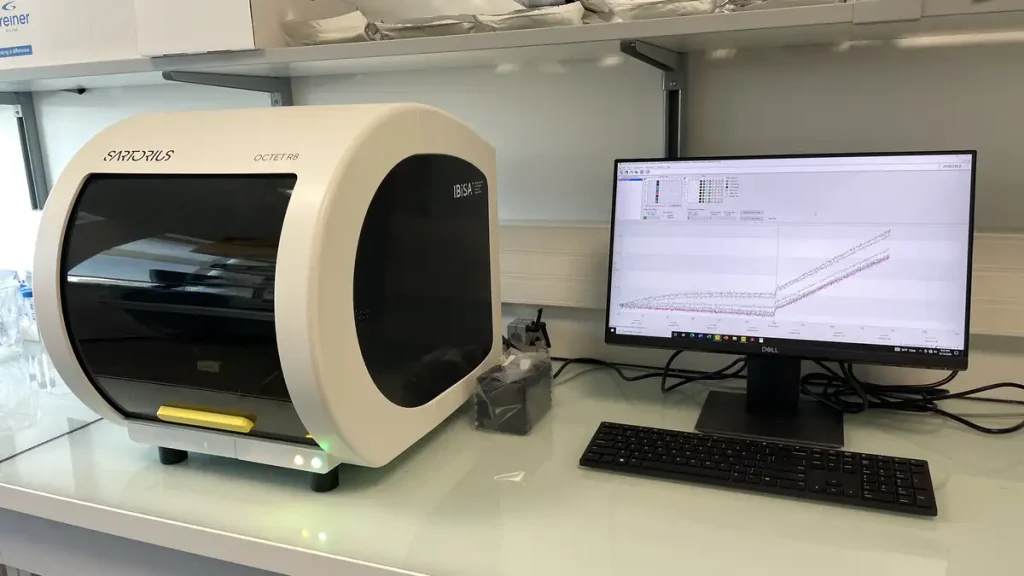
Equipment: Octet® R8 System from Sartorius
Description: the Octet detects changes in the interference pattern of white light after it is reflected back from the tip of a biosensor. One molecule is immobilized on the tip, and when its partner binds, the layer gets thicker, shifting the interference pattern (in nanometers). This shift is proportional to the amount bound. 8 measurements can be recorded in parallel.
FLOW-INDUCED DISPERSION ANALYSIS (FIDA)
FIDA combines Taylor dispersion analysis (TDA) and fluorescence detection to measure biomolecular size, enabling accurate determination of hydrodynamic radius (Rh) and size-based characterization of biomolecular interactions.
Application: FIDA technology enables the characterization of biomolecular interactions in solution. It also supports molecular size determination, protein quantification, and the assessment of aggregation, oligomerization, and biomolecular stability.
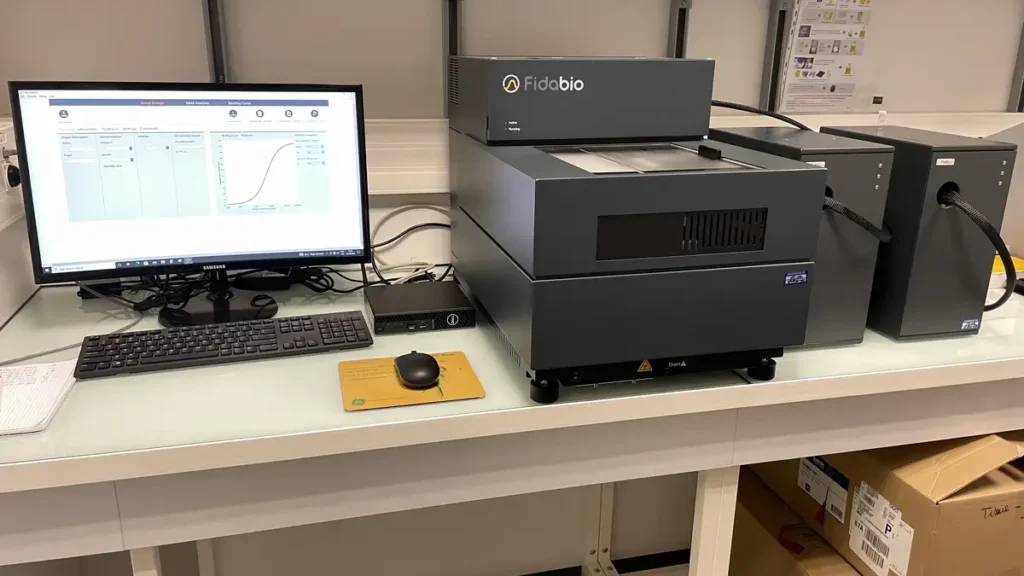
Equipment: Fida1 from Fidabio.
Description: detection is based on labelled or intrinsic fluorescence signal. The available detectors are 280 nm (UV, label free) and 480 nm (fluorescent labeling). Species of Rh between 0.5 and 1000 nm can be analyzed, and different populations resolved. Size changes down to 5% hydrodynamic radius can be detected.
ISOTHERMAL TITRATION CALORIMETRY (ITC)
ITC directly measures the heat released or absorbed during interaction events. It provides a full thermodynamic profile in one experiment: binding affinity (KD), stoichiometry (n), enthalpy (ΔH), and entropy (ΔS). It is label-free and immobilization-free, working in solution with a wide range of molecules (proteins, small molecules, nucleic acids, lipids).
Application: ITC is used to study all types of protein interactions, including protein-protein, protein-DNA/RNA and protein-small molecule interactions.
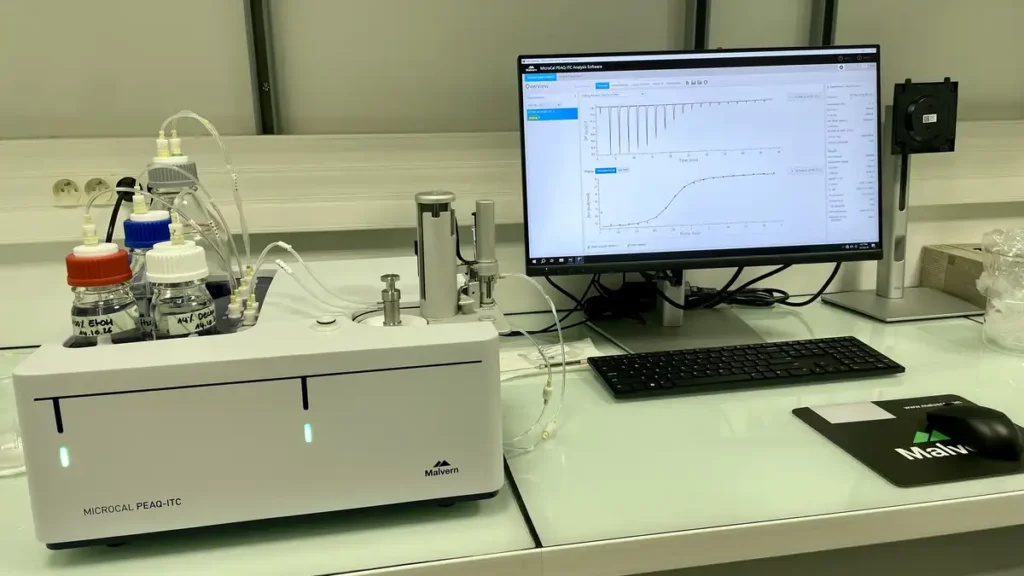
Device: Microcal PEAQ-ITC (Malvern)
Description: the PEAQ-ITC is equipped with automated cleaning of the sample cell and the titration syringe. Sample cell volume is 200 µL, and titration syringe volume is 40 µL.
MASS PHOTOMETRY (MP)
Mass photometry is a single-molecule technique, that delivers accurate mass measurements of macromolecules in solution, in their native sate.
Application: MP can detect and characterize proteins, nucleic acids, and macromolecular complexes. It provides information on oligomeric state and stoichiometry, sample homogeneity, and molecular interactions.
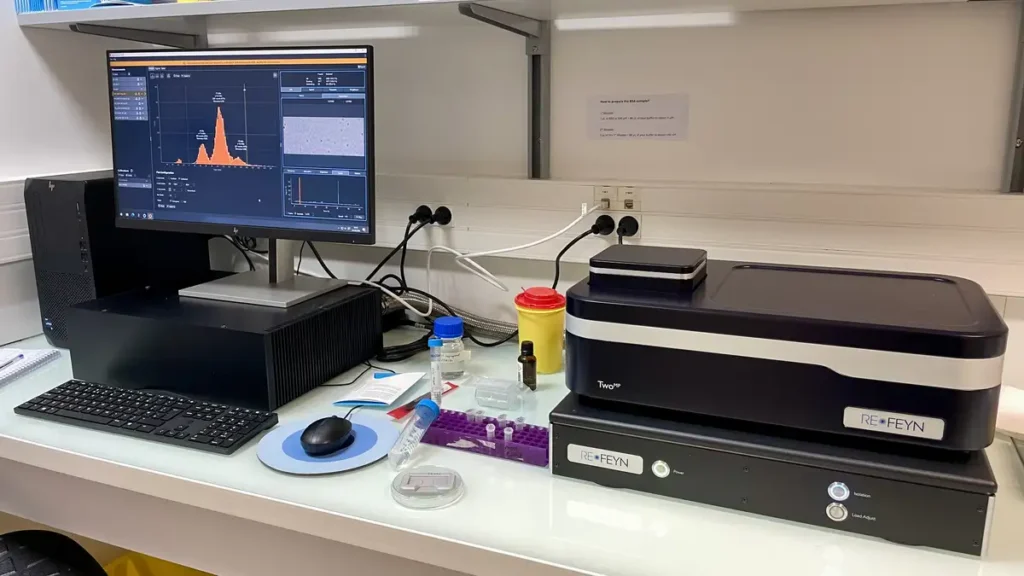
Equipment: TwoMP instrument from Refeyn.
Description: the TwoMP is a benchtop mass photometer which measures masses ranging from 30 kDa to 5 MDa, in a few minutes, with only 2 µL of sample at nanomolar concentration.
NANO DIFFERENTIAL SCANNING FLUORIMETRY (NanoDSF)
NanoDSF is a label-free technique used to evaluate the thermal stability, conformational stability, and quality of proteins. It measures changes in the intrinsic fluorescence of aromatic amino acids during thermal unfolding.
Application: the three most common applications of nanoDSF are protein stability characterization, buffer optimization, and protein–ligand interaction screening.
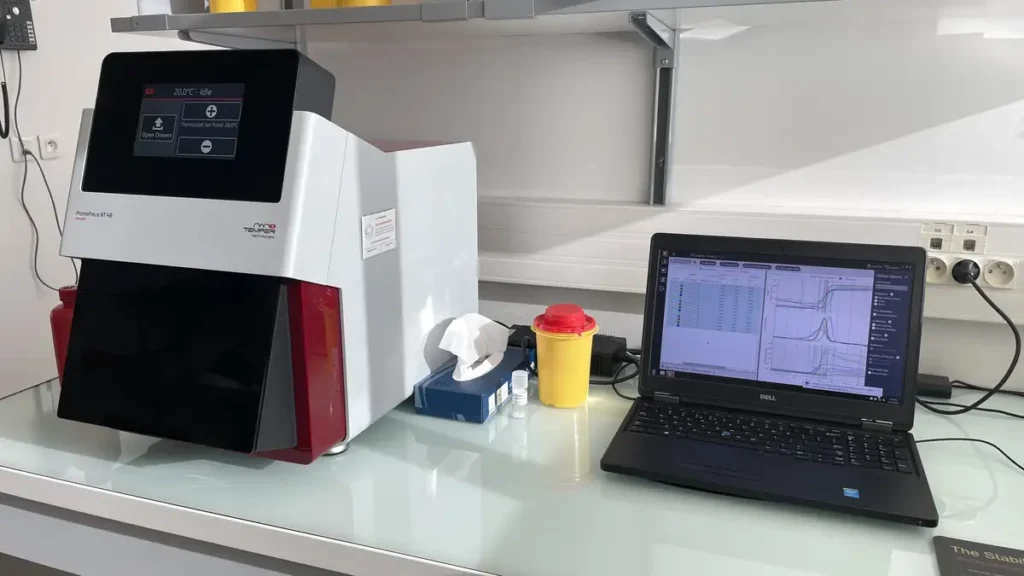
Equipement : Nanotemper Prometheus NT.48 with aggregation detection optics.
Description: the Prometheus NT.48 is a low-sample-volume instrument used to screen the thermal stability of proteins in different buffer conditions and to identify potential ligands. It can analyze 48 samples in parallel.
MICROSCALE THERMOPHORESIS (MST)
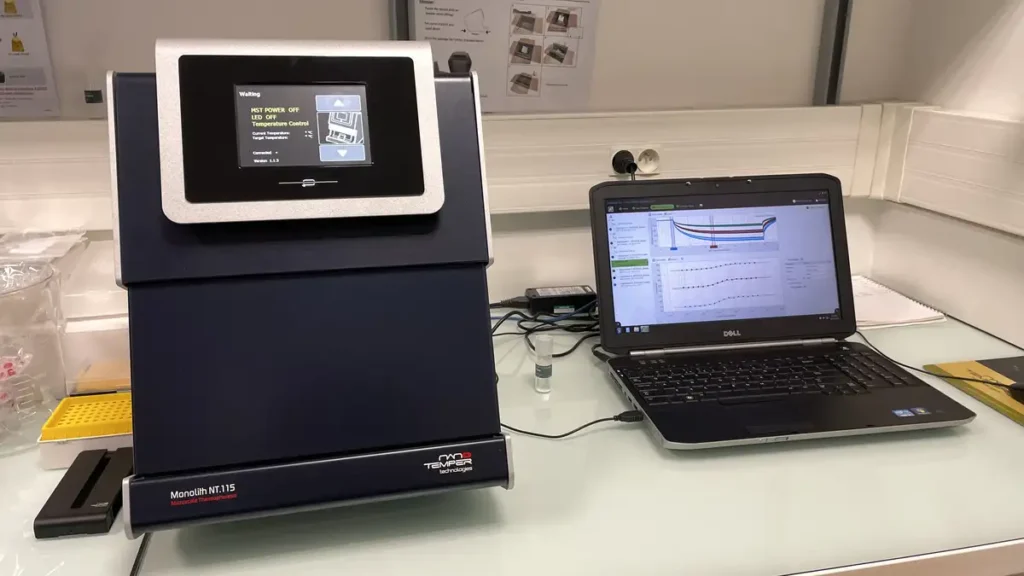
MST measures changes in mobility of molecules in microscopic temperature gradients to determine binding affinities. The magnitude and direction of this movement depend on a molecule’s size, charge, and hydration shell.
Application: MST is mainly used to measure binding affinity (KD) between biomolecules, such as proteins with other proteins, small molecules, nucleic acids, or lipids. It is widely applied in drug discovery for screening and hit validation.
Equipment: Monolith NT.115 BLUE/RED instrument (NanoTemper)Description: theMonolith NT.115 can measure affinities within nM to mM range with low sample consumption (microliters). A fluorescent labelling is required on one binding partner.