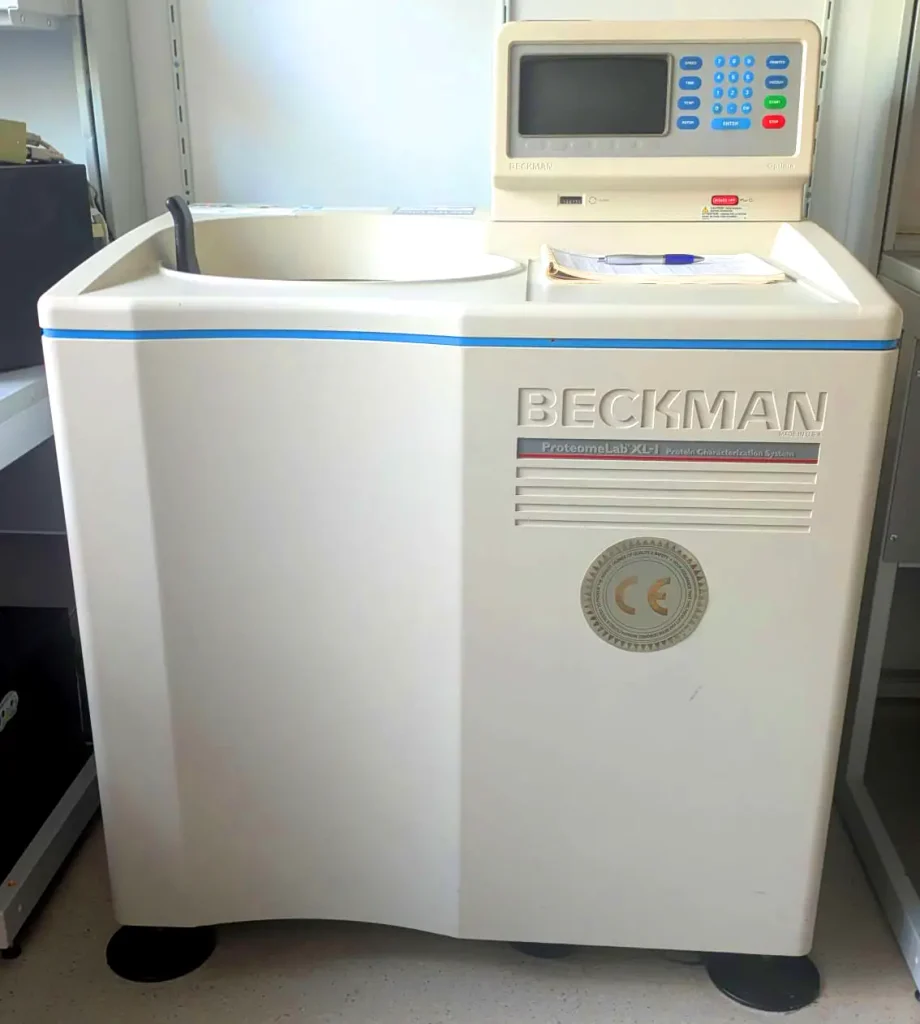
Analytical ultracentrifugation (AUC)
AUC is a powerful, label-free solution-based technique that spins macromolecules at high centrifugal speeds while using real-time optical detection to measure their physical and thermodynamic properties
Applications: Versatile, matrix-free solution technique that uses high centrifugal force and optical detection to measure the mass, shape, and interactions of macromolecules in their native environment
Equipment: Analytical ultracentrifuge XLI (Beckman) with a double detection system, absorbance and interference (Beckman), and fluorescence detector (Aviv)
Description: Analytical ultracentrifuge equipped with a built-in double detection system for absorbance and Rayleigh interference, which can also be retrofitted or paired with an external fluorescence detector from Aviv Biomedical
Website: https://www.isbg.fr/biophysics-character/article-analytical-ultracentrifugation-auc/
Bio-Layer Interferometry (BLI)
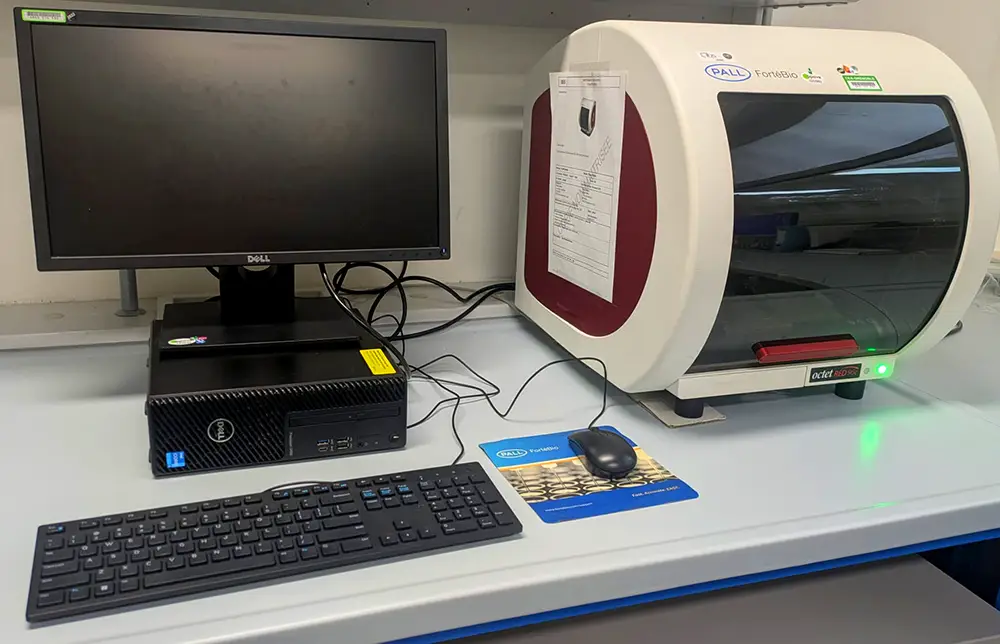
Bio-layer interferometry (BLI) is a label-free optical technique that measures biomolecular interactions in real time by tracking the shift in interference patterns of white light reflected from a biosensor tip. When molecules bind to the sensor surface, the thickness of the biolayer increases, causing a wavelength shift proportional to the amount bound — enabling measurement of association and dissociation kinetics. It’s widely used to determine kinetic rate constants (kon, koff) and affinities, notably for antibody–antigen characterization.
Applications: BLI is widely used to characterize antibody–antigen binding kinetics and affinities during therapeutic antibody development and screening. It also quantifies protein concentrations, assesses competitor binding, and maps epitopes. Its 96-well plate format and crude-sample compatibility make it popular for high-throughput drug discovery.
Description: Octet RED96e System is an advanced, label-free, real-time biosensor platform designed for high-throughput analysis of biomolecular interactions. Utilizing Bio-Layer Interferometry (BLI) technology, it enables precise quantification of binding kinetics, affinity, and concentration without the need for microfluidics, making it ideal for applications in biopharmaceutical development, quality control, and academic research.
Website: https://www.isbg.fr/biophysics-character/biolayer-interferometry/
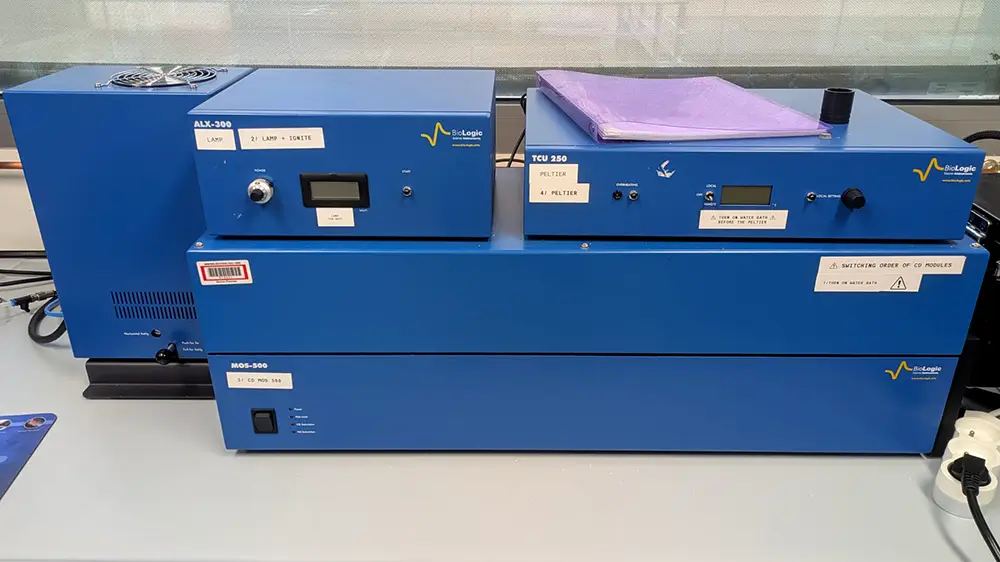
Circular dichroism (CD)
Circular dichroism (CD) is a spectroscopic technique that measures the difference in absorption between left- and right-handed circularly polarized light by chiral (asymmetric) molecules
Applications: Secondary structure determination: Far-UV CD (180–260 nm) analyzes the peptide backbone to estimate the fraction of α-helices, β-sheets, and random coils. Also, Monitors protein unfolding kinetics, thermal denaturation, and refolding pathways in response to temperature, pH, or denaturants.
Equipment: Circular dichroism (CD) (MOS-500 Biologic)
Description: The MOS-500 spectropolarimeter specifically optimized for both steady state and rapid kinetics applications. The CD spectrometer guarantees excellent performance: sensitivity, precision, speed and modularity from far-UV to NIR region. .
Website: https://www.isbg.fr/biophysics-character/circular-dichroism-mos500/
Isothermal Titration Calorimetry (ITC)
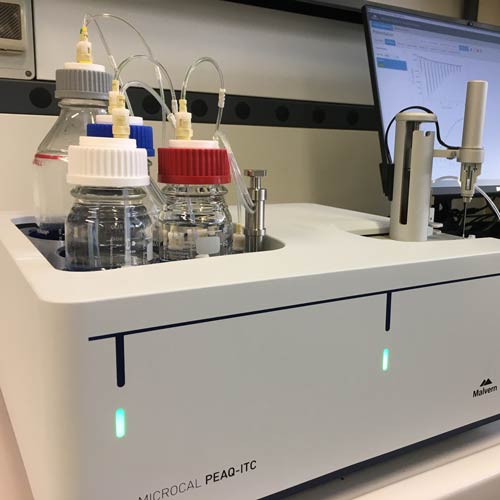
Isothermal titration calorimetry ITC is a technique for measuring affinity and thermodynamics of molecular complexes.
Applications: Determination of affinity constants in protein/protein or protein/ligand or protein/DNA interactions. Determination of the stoichiometry of the biochemical interaction. Determination of thermodynamic constants (enthalpy and entropy).
Equipment: Isothermal titration calorimeter PeaQ ITC (Malvern InstrumentsTM)
Description: The MicroCal PEAQ-ITC (Malvern Panalytical) is an automated isothermal titration calorimetry system that directly measures heat released or absorbed during biomolecular interactions. Label-free and in-solution, it determines binding affinity (Kd), stoichiometry (n), enthalpy (ΔH), and entropy (ΔS) in a single experiment. It is a standard tool for characterizing protein–ligand and antibody–antigen interactions in drug discovery.
Website: https://www.isbg.fr/biophysics-character/article-presentation-itc/
Mass Photometer (MP1)
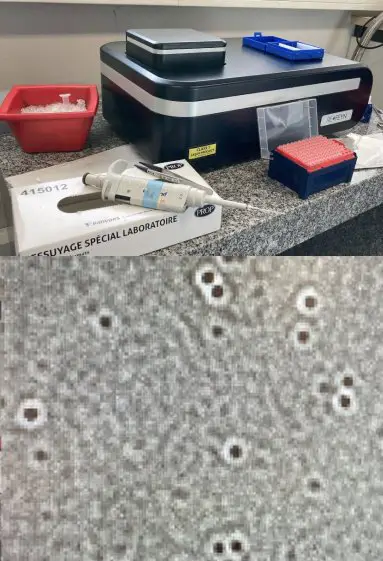
Mass Photometer (MP1) is designed to measure the true molecular mass of single particles and biomolecules directly in solution without the use of fluorescent labels or tags. The technology behind the OneMP is based on interferometric scattering (iSCAT) microscopy.
Applications: MP1 is a single-molecule analytical technique that determines the molecular weight of biomolecules in their native state without the need for labels
Equipment: MPOne from Refeyn
Description: Octet RED96e System is an advanced, label-free, real-time biosensor platform designed for high-throughput analysis of biomolecular interactions. Utilizing Bio-Layer Interferometry (BLI) technology, it enables precise quantification of binding kinetics, affinity, and concentration without the need for microfluidics, making it ideal for applications in biopharmaceutical development, quality control, and academic research.
Website: https://www.isbg.fr/biophysics-character/mass-photometer-mpone/
Size-Exclusion Chromatography coupled with Multi-Angle Light Scattering (SEC-MALS)
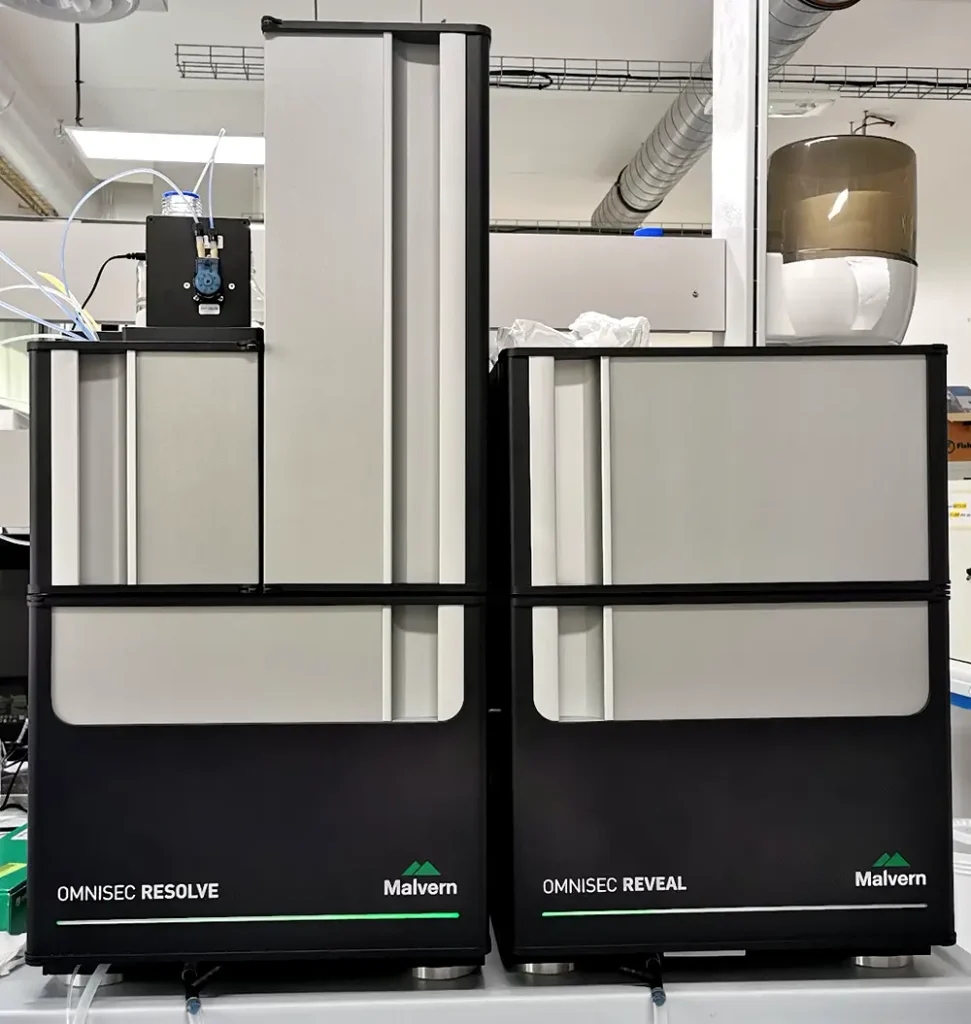
SEC-MALLS is a powerful analytical technique used in chemistry, biochemistry, and polymer science to determine the absolute molecular weight, size, and conformation of macromolecules in solution
Applications: Determines absolute molar mass, oligomeric states, and aggregation from proteins. Also, it resolves multi-component macromolecules (such as glycoproteins or protein-nucleic acid complexes) by combining UV, refractive index, and MALS detectors to find the mass fraction of each constituent
Equipment: OMNISEC (Malvern Instruments TM)
Description: Malvern Panalytical’s OMNISEC is an advanced multi-detector Gel Permeation Chromatography (GPC) and Size Exclusion Chromatography (SEC) system designed for the precise characterization of synthetic polymers, natural polymers, polysaccharides, and proteins
Website: https://www.isbg.fr/biophysics-character/sec-mals-omnisec-and-protein-analysis-on-line-paol/
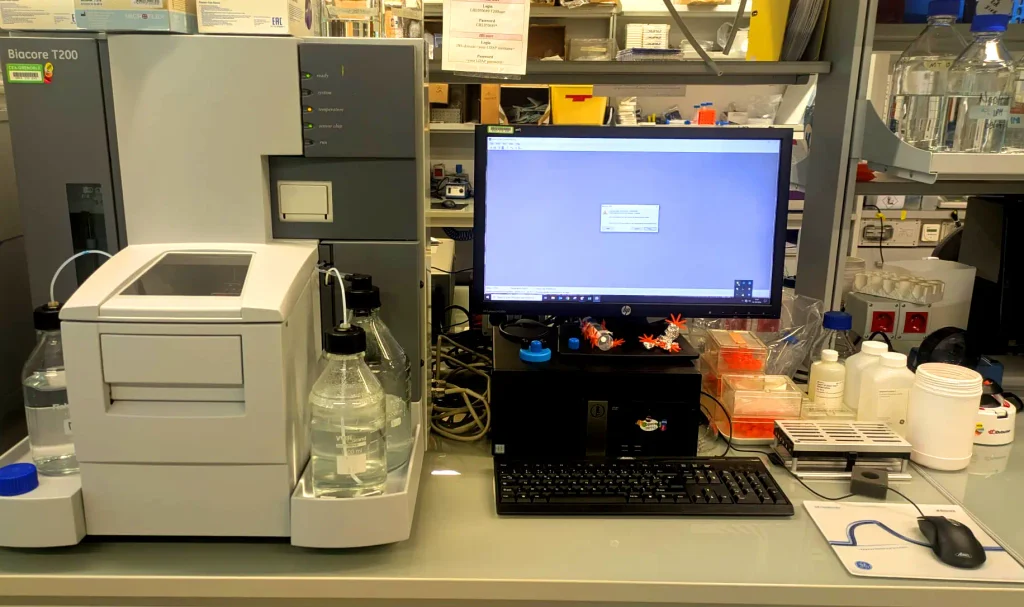
Surface plasmon resonance (SPR)
SPR s a label-free optical technique used to measure real-time molecular interactions by detecting changes in the refractive index near a thin metal film
Applications: It monitors real-time binding interactions between molecules by measuring changes in the refractive index at a metal-dielectric interface
Equipment: Biacore T200 from Cytivia
Description: the T200 is a versatile, label-free system for detailed
studies of biomolecular interactions. Run 384 samples unattended and quickly co-evaluate up to 5000 samples in a single evaluation
Website: https://www.isbg.fr/biophysics-character/article-surface-plasmon-resonance/